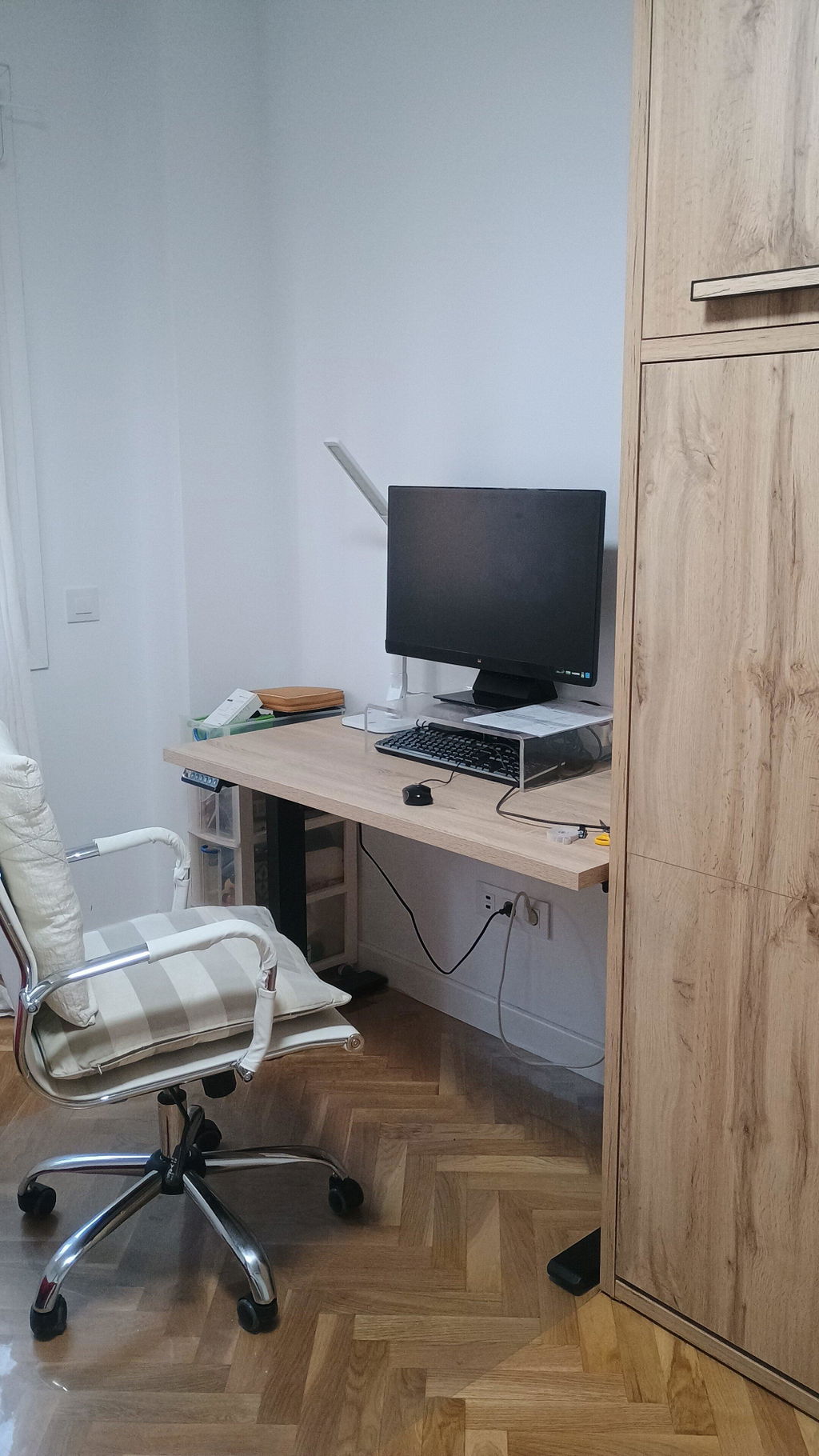

Height-adjustable vs. fixed-height desks: real differences
Compartir
For years, working at a fixed desk was the norm.
A desk.
A chair.
A computer.
Eight hours sitting.
And that's it.
But work has changed: more and more people are working from home. More hours in front of the computer. More video calls. More concentration tasks. More time in the same place.
And when you spend a good part of the day in your workspace, the desk is no longer just a piece of furniture. It becomes a very important element of the workspace.
That's where the question arises:
Is an adjustable standing desk worth it, or is a fixed desk enough?
The short answer is this:
If you use the desk occasionally, a fixed desk may be sufficient.
If you work long hours in front of the computer, an adjustable standing desk makes much more sense.
Now let's take a closer look.
The main difference: who adapts to whom
A fixed desk has a fixed height.
It's usually around 72-75 cm.
That height might work for you. Or not.
It depends on your height, your chair, your arm height, the screen, the keyboard, and how you work.
The problem is that the desk doesn't change.
The desk is there. You adapt.
- You raise the chair.
- You lower the chair.
- You shrug your shoulders.
- You lean in a bit.
- You put a cushion.
- You elevate the screen with one or two thick books.
- You look for a posture that sort of works.
- An adjustable standing desk works the other way around.
You are not the one who adapts to the desk. It's the desk that adapts to you.
You can adjust the height to work sitting. You can raise it to work standing. You can save your favorite heights. You can change your posture during the day.
That's the fundamental difference.
It seems small.
It's not.
A fixed desk is not bad. But it has limits.
We're not going to say that a fixed desk is always a bad purchase.
That wouldn't make sense.
For many people, a fixed desk can be enough.
If you use the desk for only a few hours a day, if you don't usually work from home, or if you only need a surface for specific tasks, a fixed desk can perfectly fulfill its purpose.
The problem arises when the desk becomes your main workstation.
When you work there every day.
When you spend 6, 7, or 8 hours in front of the computer.
When you start to notice that at the end of the day you're stiff, tired, or want to get up every so often.
In that context, a fixed desk falls short because it forces you to always maintain the same work logic: sitting, at the same height, for many hours.
And the body is not designed for that.
It doesn't need a perfect posture.
It needs movement.
The key is not to work standing. It's to be able to change posture.
This point is important.
An adjustable standing desk is not for working standing all day.
That would be trading one problem for another.
Spending eight hours sitting is not ideal. But spending eight hours standing isn't either.
The real advantage of an adjustable standing desk is the alternation.
- You work sitting for a while.
- You raise the desk.
- You make a video call standing.
- You lower the desk.
- You type sitting.
- You raise it again to review documents, answer emails, or get a little unstuck.
It's not about becoming a standing statue.
It's about breaking the fixed posture.
If you want to delve deeper into this, you can read our guide on how many hours are recommended to work standing.
Quick Table: Fixed Desk vs. Adjustable Standing Desk
| Factor | Fixed Desk | Adjustable Standing Desk |
|---|---|---|
| Height | Always the same height. You adapt to the desk. | Adjustable height. The desk adapts to you. |
| Posture | You usually work sitting throughout the day. | You can alternate between sitting and standing. |
| Ergonomics | Depends heavily on whether the fixed height suits you. | Allows better height adjustment according to your body and chair. |
| Movement | Promotes a more static routine. | Makes it easier to incorporate more movement during the day. |
| Shared Use | May not work well if used by several people. | Each person can adjust their ideal height. |
| Intensive Telework | May fall short if you work long hours. | Makes more sense for long days in front of the computer. |
| Price | Usually more economical. | Higher initial investment. |
| Long-term Value | Serves as a work surface. | Improves workstation adaptability for years. |
Ergonomics: The Fixed Desk Depends Too Much on Luck
To work comfortably in front of the computer, there's a simple reference:
- Elbows should be close to 90 degrees.
- Shoulders should be relaxed.
- The screen should be at an appropriate height.
- Wrists should not be forced.
- Feet should be well supported.
With a fixed desk, everything depends on the desk's height matching your body and your chair.
Sometimes it happens.
Many times, it doesn't.
- If the desk is too high, you raise your shoulders.
- If it's too low, you tend to hunch over.
- If the monitor is low, you tilt your neck.
- If the keyboard is far away, you stretch your arms.
At first, it seems minor.
After several hours, it's noticeable.
With an adjustable standing desk, you can adjust the desk's height much more precisely. And that helps build a more comfortable working posture, both sitting and standing.
It doesn't work magic.
But it gives you leeway.
And when you work many hours, leeway matters.
You can see more on this topic in our guide on correct posture in front of the computer.
Movement: The Big Advantage of the Adjustable Standing Desk
The great advantage of an adjustable standing desk is not just the height.
It's the change in dynamic.
A fixed desk invites you to sit down and stay there.
An adjustable standing desk reminds you that you can move.
- You can stand up for a call.
- You can answer emails standing.
- You can review a presentation without being slumped in your chair.
- You can change your posture when you feel yourself losing focus.
- You can start the morning standing and sit down later.
- You can take more natural breaks.
It's not about working more.
It's about working with less stiffness.
The adjustable standing desk makes movement easy.
And that's what's important.
Because if moving requires stopping, gathering things, changing places, or performing a ritual, you won't do it.
If all it takes is pressing a button, you're much more likely to incorporate it.
Concentration and energy: it's not all about posture
Sometimes you're not tired just because you've worked a lot.
Sometimes you're tired because you've been in the same position for too long.
You slide down in your chair.
You look down.
You hunch your back.
You struggle to concentrate.
You don't always need another coffee.
Sometimes you need to change your posture.
Working standing up for certain periods can help you change the mental rhythm of your day. Especially for tasks like calls, meetings, reviewing documents, or more active work blocks.
An adjustable standing desk doesn't make you a more productive person on its own.
But it does give you a tool to better manage your energy throughout the day.
The desk doesn't do the work for you.
But it can help you work in better conditions.
Workspace: from table to complete workstation
A fixed desk is usually seen as a surface.
An adjustable standing desk should be considered the center of a workstation.
- Desk.
- Chair.
- Monitor.
- Keyboard.
- Mouse.
- Lighting.
- Cable management.
- Accessories.
- Movement habits.
Everything counts.
You can have a good adjustable standing desk and underuse it if you work with your laptop too low, with the mouse too far away, or with cables hanging everywhere.
That's why it's important to think of the desk as part of an ecosystem.
First, a stable and adjustable desk.
Then, a comfortable chair.
Next, the monitor at the correct height.
And, if you want a tidier setup, accessories like a monitor arm, cable tray, or cable organizer.
You don't have to do it all on the first day.
But it is good to have a clear idea: your workspace should help you work better, not force you to improvise.
Price: The Fixed Desk Wins at First, but Not Always in the Long Run
A fixed desk is usually cheaper.
That's obvious.
The question is whether the initial price is the only data that matters.
If you're going to use the desk infrequently, maybe so.
But if you work there every day for years, it's worth looking at the purchase differently.
- How many hours do you spend in front of the computer?
- How many years do you expect the desk to last?
- How much value does working with more comfort have?
- How important is it that the workstation adapts better to you?
A good adjustable standing desk is not an impulse buy.
It's an investment in your workspace.
And at Tablakala, we see it this way: don't buy a desk because it goes up and down. Buy a desk because it's stable, durable, well-made, and makes sense for your routine.
It's not a gadget.
It's serious office furniture.
Stability: where many adjustable standing desks fail
Here we must be clear.
Not all adjustable standing desks are created equal.
Just because a desk goes up and down doesn't mean it's good.
Stability is one of the most important points, especially when you work with the desk elevated.
And stability doesn't appear by magic.
It is given by the amount of material in the structure, the weight of the desk, the width of the columns, the size of the feet, the design of the structure, and the thickness of the tabletop.
In other words:
If a desk weighs half as much, something has been removed.
Normally, material.
That's why it's worth looking at the technical data, not just the photos.
A desk with larger feet, wider columns, a heavier frame, and a thicker tabletop usually performs better than an ultralight desk that promises a lot and shows little.
At Tablakala, we talk about weight, measurements, and thickness because these are important data.
The Tablakala 2 Motors, for example, has a heavier frame, wider columns, larger feet, and a 3 cm thick tabletop. It's no coincidence that it's our most stable desk.
Look at measurements and weight and compare.
When to choose a fixed desk?
A fixed desk can make sense if:
- You work few hours at that desk.
- You have a very tight budget.
- You don't need to alternate between sitting and standing.
- You already have a chair and setup that fit well.
- You are simply looking for a support surface.
- You don't habitually work from home.
In these cases, a fixed desk can suffice.
Not everyone needs an adjustable standing desk.
And to say otherwise would be selling for the sake of selling.
When to choose an adjustable standing desk?
An adjustable standing desk makes more sense if:
- You work many hours in front of the computer.
- You telework several days a week.
- You experience discomfort from sitting for long periods.
- You want to alternate between working sitting and standing.
- You use multiple screens or a full workstation.
- You share the desk with another person.
- You want a more adaptable desk long-term.
- You are taking your workspace seriously.
- Here, the adjustable desk stops being a whim.
It becomes a quite logical decision.
If you work long hours in the same place, that place should be well thought out.
Is a 1-motor or 2-motor adjustable standing desk better?
The usual answer is: it depends on your situation.
The Tablakala 1 Motor is a very balanced option for most users. It has good stability, supports up to 70 kg, and works very well for normal teleworking setups: laptop, one screen, keyboard, mouse, and common accessories.
The Tablakala 2 Motors is the most complete option. It supports up to 125 kg, has a greater height range, more stability, and is designed for those who want a more robust desk or work with multiple screens.
If you are looking for a smart purchase for teleworking, the Tablakala 1 Motor makes a lot of sense.
If you want more desk, more leeway, and more stability, the Tablakala 2 Motors is the natural choice.
You can see all our adjustable standing desks and compare available models, sizes, and finishes.
How to use an adjustable standing desk well
Buying an adjustable standing desk is not enough.
You have to use it.
It's like joining a gym.
Joining changes nothing if you don't go.
It's the same with a Tablakala: the desk allows you to alternate postures, but you have to incorporate it into your routine.
You can start with something simple:
Work 30-45 minutes sitting.
Raise the desk and work 15-20 minutes standing.
Use calls to stand up.
Lower the desk for long typing tasks.
Take short breaks throughout the day.
No need to complicate it.
A little movement every day is better than trying to make it perfect for two days and then abandoning it.
So, adjustable standing desk or fixed desk?
If you're going to use the desk occasionally, a fixed desk may be sufficient.
If you work long hours in front of the computer, an adjustable standing desk is a more complete, more adaptable, and more logical option.
Because it doesn't force you to choose a single posture.
It allows you to change.
And working better isn't always about adding more things.
Sometimes it's about removing rigidity.
Frequently asked questions about adjustable standing desk vs. fixed desk
Is it worth buying an adjustable standing desk?
Yes, especially if you work long hours in front of the computer or telework regularly. It allows you to alternate between working sitting and standing, better adjust the desk height, and build a more adaptable workstation.
Is it bad to always work sitting at a fixed desk?
It's not that sitting is bad in itself. The problem is spending too many hours in the same posture without moving. An adjustable standing desk helps introduce posture changes throughout the day.
Does an adjustable standing desk improve posture?
It can help, as long as you use it correctly. The desk allows for better height adjustment and alternating postures, but the chair, monitor, keyboard, mouse, and your movement habits also matter.
Does an adjustable standing desk replace a good chair?
No. They are different things. A good chair is still important. The adjustable standing desk adds another layer: it allows you not to depend solely on sitting throughout the day.
What is better, a 1-motor or 2-motor adjustable standing desk?
For most normal setups, a 1-motor adjustable standing desk may be sufficient. If you use multiple screens, want more stability, more load capacity, and a wider height range, a 2-motor adjustable standing desk makes more sense.
Can an adjustable standing desk be used as a normal desk?
Yes. An adjustable standing desk can be perfectly used as a traditional desk. The difference is that you can also adjust its height and work standing whenever you want.
Conclusion: A Fixed Desk Serves. An Adjustable Desk Adapts.
A fixed desk can suffice.
But an adjustable standing desk offers something more important than a motor:
Adaptability.
- You can adjust the height.
- You can alternate postures.
- You can work sitting.
- You can work standing.
- You can adapt the desk to your body, your chair, your equipment, and your workday.
- If you use the desk infrequently, a fixed desk may suffice.
If you work there many hours, every day, a height-adjustable desk makes much more sense.
Not because it's a trend.
But because work has changed.
And your desk should too.