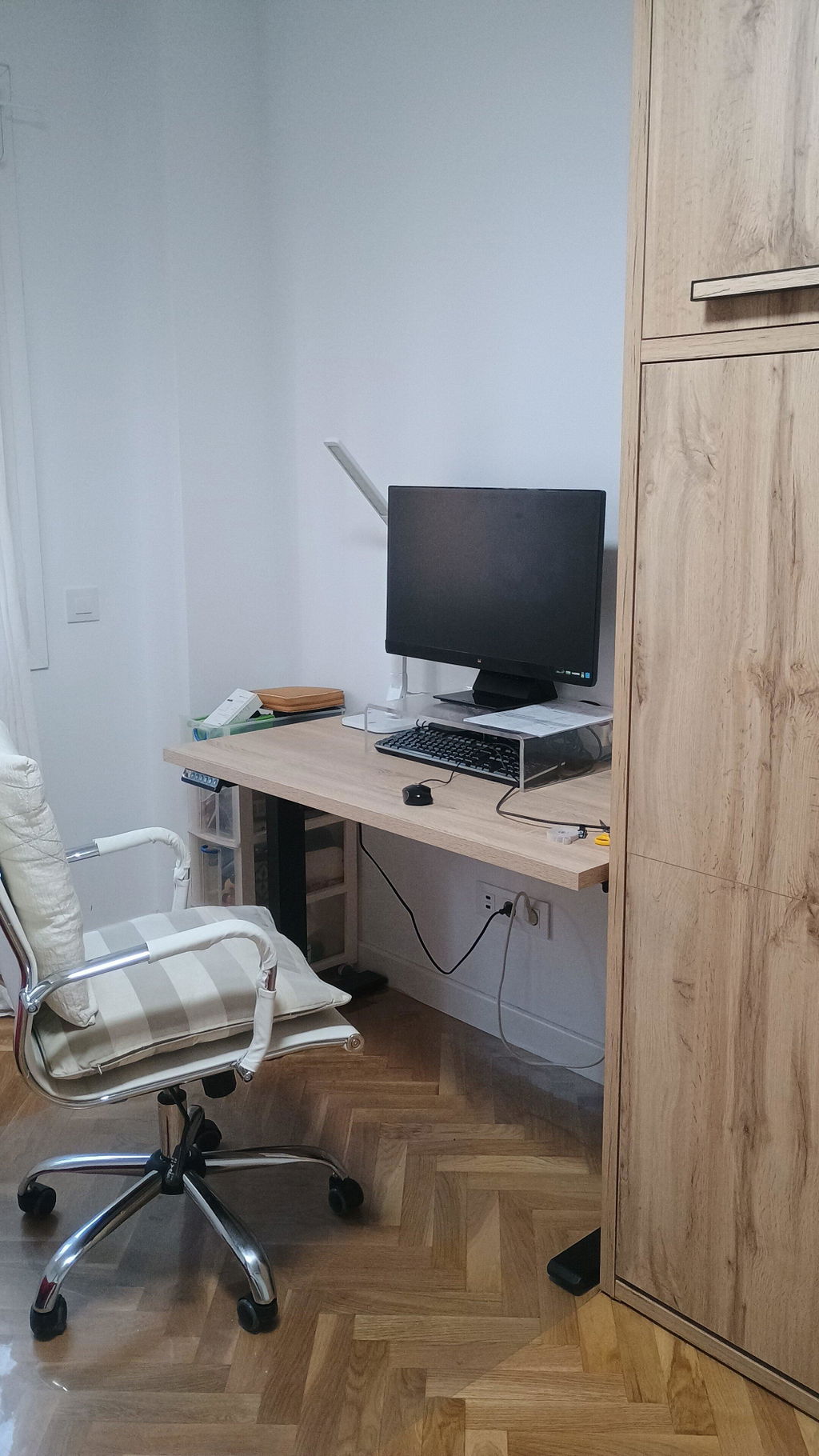

What standing desk to choose based on your height, space, and work style
Compartir
Choosing a standing desk seems easy.
You see a desk that goes up and down. You like the color. You look at the price. You buy it.
But if you work long hours in front of the computer, it's worth choosing with a little more care.
Because not all standing desks are the same. And not all people need the same thing.
- Being 5'2" is not the same as being 6'5".
- Working with a laptop is not the same as working with three screens.
- Having a spacious office is not the same as having a small room.
- Using the desk two hours a day is not the same as working eight hours from home.
A good standing desk should adapt to you.
To your height.
To your space.
To your equipment.
To your way of working.
In this guide, we help you choose the standing desk that best suits you.
First: don't choose just by the picture
A desk can look great in a photo.
It's another thing how it performs when you use it every day.
When buying a standing desk, pay attention to the important data:
- The minimum and maximum height.
- The stability of the structure.
- The weight it supports.
- The compatible tabletop size.
- The thickness of the tabletop.
- The weight of the structure.
- The warranty.
- Real reviews.
- Who is behind it if you have any problems.
Don't buy a standing desk just because it looks nice in an image. Look at measurements, weight, materials, and support.
That's where you see the difference.
1. Choose according to your height
Height is one of the most important points.
A standing desk makes sense because it allows you to work seated and standing. But to do it well, it must have a height range that fits your body.
When working seated or standing, the basic reference is simple: your elbows should be close to 90 degrees and your shoulders relaxed.
If you have to raise your shoulders to type, the desk is too high.
If you have to hunch over, the desk is too low.
That's why the elevation range matters.
At Tablakala, the two models cover different profiles:
- Tablakala 1 Motor has an elevation range of 71 to 121 cm (28 to 47.6 inches). It's a very balanced option for people approximately 160 to 195 cm (5'3" to 6'5") tall.
- Tablakala 2 Motors has an elevation range of 58 to 123 cm (22.8 to 48.4 inches). It's a more advanced option, especially interesting for shorter people, tall people, or users who want more adjustment margin.
If you want to delve deeper into this point, you can read our guide on the ideal desk height.
2. Choose according to the space you have
The best standing desk is not the biggest one.
It's the one that fits well in your space.
If you work in a small room, a tabletop that is too large can make the office feel heavy and uncomfortable.
If you have a spacious office, a small tabletop might fall short as soon as you start adding a monitor, laptop, keyboard, mouse, notebook, lamp, or accessories.
As a reference:
- A 100x60 cm (39.4x23.6 in) tabletop can work for small spaces and very simple setups.
- A 120x60 cm (47.2x23.6 in) tabletop is usually a very practical option for teleworking with a laptop and one screen.
- A 140x70 cm (55.1x27.6 in) tabletop is one of the most balanced sizes for comfortable work.
- A 160x80 cm (63x31.5 in) tabletop makes sense if you want more surface area, use multiple screens, or want a spacious workstation.
The key is to leave enough space to work without the desk dominating the entire room.
A good desk should help you work better. Not become an obstacle.
3. Choose according to your work equipment
Working with a laptop is not the same as working with a complete setup.
If you only use a laptop, keyboard, and mouse, you don't need the same structure as someone who works with two monitors, a monitor arm, speakers, a charging base, a lamp, and various accessories.
Here it's important to look at two things: the maximum load the desk can support and the stability of the structure.
Here it's important to look at two things: the maximum load the desk can support, and the stability of the structure.
Because stability is determined by the amount of material the desk has, the weight of the structure, the width of the columns, the size of the feet, and the thickness of the tabletop.
In other words: if a desk weighs half as much, something has been removed, and it's usually material.
Therefore, when comparing standing desks, don't just look at the photo or the promise of a “stable desk.” Look at the data:
- The weight of the structure.
- The width of the columns.
- The size of the feet that rest on the floor.
- The thickness of the tabletop.
- The maximum load capacity.
A more robust structure usually performs better when the desk is elevated, especially if you work with multiple screens or a large tabletop.
At Tablakala, this is especially noticeable in the Tablakala 2 Motors: a heavier structure, wider columns, larger feet, and a 3 cm thick tabletop. It's no coincidence that it's the most stable standing desk on the market.
- Tablakala 1 Motor supports up to 70 kg (154 lbs). For most teleworking setups, it's more than enough: laptop, one screen, keyboard, mouse, and normal accessories.
- Tablakala 2 Motors supports up to 125 kg (275 lbs). It has more capacity, more stability, and more margin if you use multiple screens or want a more robust desk.
In other words: if you have a simple setup, Tablakala 1 Motor is a very smart purchase. If you want maximum stability, work with multiple screens, or are looking for a more advanced desk, Tablakala 2 Motors is the natural choice.
Quick table: which standing desk to choose
| Your case | Recommended model | Why |
|---|---|---|
| You are between 160 and 195 cm (5'3" and 6'5") tall and work with a normal setup | Tablakala 1 Motor | Good value for money, sufficient height, and plenty of support for regular teleworking. |
| You are shorter than 160 cm (5'3") | Tablakala 2 Motors | Its minimum height range allows for better desk adjustment for shorter people. |
| You are taller than 195 cm (6'5") | Tablakala 2 Motors | Offers more adjustment margin and a more robust structure. |
| You use a laptop and one screen | Tablakala 1 Motor | It is sufficient for most home workstations. |
| You use two or three screens | Tablakala 2 Motors | More stability, more load capacity, and better performance with heavy setups. |
| You have little space | Tablakala 1 Motor | Fits better with compact configurations and small tabletops. |
| You want a spacious desk of 140x70 cm (55.1x27.6 in) or 160x80 cm (63x31.5 in) | Tablakala 2 Motors | Better choice if you are looking for a more stable, larger desk prepared for many years. |
| You are looking for the best value for money option | Tablakala 1 Motor | Balanced, stable, and sufficient for most users. |
| You are looking for the most complete option | Tablakala 2 Motors | More range, more load capacity, more stability, and better features. |
4. Choose according to your working style
This point is often forgotten.
Not everyone works the same way.
Some people make a lot of video calls.
Others write for hours.
Others design, edit video, or work with multiple screens.
Others need to move to concentrate.
Others simply want to get up more often and not spend all day sitting.
A standing desk should not be seen as just a table.
It is the foundation of your workstation.
It allows you to alternate between various postures: seated for deep concentration tasks. Standing for calls, meetings, or moments of lower energy. Moving during short breaks or block changes.
The idea is not to work standing all day; the idea is not to spend eight hours in the same posture.
If you are going to use the desk occasionally, Tablakala 1 Motor may be more than enough.
If you know you are going to use it every day, several times a day, with a lot of equipment on it, and you want a more solid experience, the Tablakala 2 Motors makes more sense.
5. Choose according to the type of workstation you want to build
A standing desk doesn't work alone. It's part of a whole:
- Chair.
- Monitor.
- Keyboard.
- Mouse.
- Lighting.
- Cable management.
- Free space.
- Movement habits.
You can have an excellent desk and ruin the experience if the monitor is too low, if the chair is not supportive, or if you work with tense shoulders.
That's why it's convenient to think of the desk as the center of a complete workstation.
First, the desk.
Then, a comfortable chair.
Then, a monitor at the correct height.
Then, a keyboard and mouse placed correctly.
And finally, accessories that organize the space: monitor arm, cable management tray, cable organizer, or laptop stand.
You don't have to buy everything on the first day.
But it is important to have a clear idea: your workspace should help you work better, not force you to adapt to it.
6. Tabletop included or just frame?
At Tablakala, you can buy the complete standing desk, with frame and tabletop, or buy only the frame and place your own compatible tabletop.
This is useful if you already have a tabletop you like, if you want a specific size, or if you prefer to buy the tabletop on your own.
But there is an important point: the tabletop must be compatible.
Not just any thin, weak, or poorly sized tabletop will do.
A good tabletop provides stability, presence, and durability.
Tablakala tabletops are manufactured in Spain, are made of high-quality agglomerated wood, are 3 cm thick, and are easy to clean with a damp cloth.
And that shows. Not just visually. Also in stability and the feeling of a serious desk.
7. Tablakala 1 Motor or Tablakala 2 Motors?
This is the usual question.
And the answer depends on what you need.
- Tablakala 1 Motor is a very balanced option. It is stable, supports up to 70 kg (154 lbs), and perfectly covers most teleworking and home office setups.
- Tablakala 2 Motors is the most advanced option. It has a higher load capacity, more stability, more height range, and better features for those who want a more complete desk.
Simply put:
The Tablakala 1 Motor is the smart purchase if your budget is tight.
The Tablakala 2 Motors is the choice for those who want more desk.
More structure.
More stability.
More capacity.
More margin.
If you want to compare both models in detail, you can read our complete guide on the differences between Tablakala 1 Motor and Tablakala 2 Motors.
8. Don't buy the cheapest standing desk. Buy the one that makes sense
A cheap standing desk may seem like a good idea at first.
Until it rises and wobbles too much in the standing position.
Until the tabletop seems weak.
Until the motor starts to fail.
Until you can't find anyone to respond.
Until you have to buy another desk in a year.
A good desk should last. That's why it's worth looking beyond the price.
Look at the weight of the structure.
Look at the thickness of the tabletop.
Look at the warranty.
Look at the reviews.
See if the company responds from Spain.
See if there are parts, support, and real attention.
If it weighs half as much, it's not magic. Something has been removed.
Usually, material.
And in a standing desk, material matters.
9. So, which standing desk should you choose?
If you're looking for a balanced option for teleworking, with good stability, good value for money, and a normal setup, choose Tablakala 1 Motor.
If you want a more robust desk, use multiple screens, are shorter than 160 cm or taller than 195 cm, or want the most complete option, choose Tablakala 2 Motors.
If you have little space, start with a compact size.
If you have a spacious office, go for 140x70 cm (55.1x27.6 in) or 160x80 cm (63x31.5 in).
If you work long hours, don't choose just thinking about today. Choose thinking about the coming years.
Because a standing desk is not an accessory.
It's the foundation of your workspace.
Frequently asked questions about choosing a standing desk
Which is the best standing desk for teleworking?
For most people who telework with a laptop, one screen, keyboard, and mouse, the Tablakala 1 Motor is a very balanced option.
If you work with multiple screens, seek maximum stability, or want a more advanced desk, the Tablakala 2 Motors makes more sense.
What standing desk size should I choose?
It depends on the space and the equipment you use.
For small spaces, 100x60 cm (39.4x23.6 in) or 120x60 cm (47.2x23.6 in) can work well. For a more comfortable workstation, 140x70 cm (55.1x27.6 in) is usually a very balanced size. If you have space and work with multiple screens, 160x80 cm (63x31.5 in) offers more surface area and comfort.
Which standing desk should I choose if I am tall?
If you are taller than 195 cm (6'5"), we usually recommend Tablakala 2 Motors. It has more adjustment range and a more robust structure.
Which standing desk should I choose if I am short?
If you are shorter than 160 cm (5'3"), the Tablakala 2 Motors is usually the best option because it goes lower than the Tablakala 1 Motor and allows for better adjustment of the working posture.
Is a 2-motor standing desk worth it?
Yes, if you are looking for more stability, more load capacity, more height range, and a more complete experience. Not everyone needs it, but if you work long hours, use multiple screens, or want a more robust desk, it's worth it.
Can I buy just the standing desk frame?
Yes. At Tablakala, you can buy the complete desk or just the frame, and place a compatible tabletop on your own. In that case, make sure to respect the compatible measurements and use a sufficiently solid tabletop.
Conclusion: choose wisely
Choosing a standing desk is not about buying the cheapest desk.
Nor the biggest one.
It's about choosing the desk that fits your body, your space, and your way of working.
If you want a balanced, serious, and very good option for most users, the Tablakala 1 Motor makes a lot of sense.
If you want a more robust desk, with more margin and more features, the Tablakala 2 Motors is the natural choice.
The important thing is not to buy blindly.
Look at measurements.
Look at weight.
Look at stability.
Look at the tabletop.
Look at the warranty.
See who responds behind it.
A good standing desk is not an expense.
It's a smart investment in the place where you spend a good part of your day.