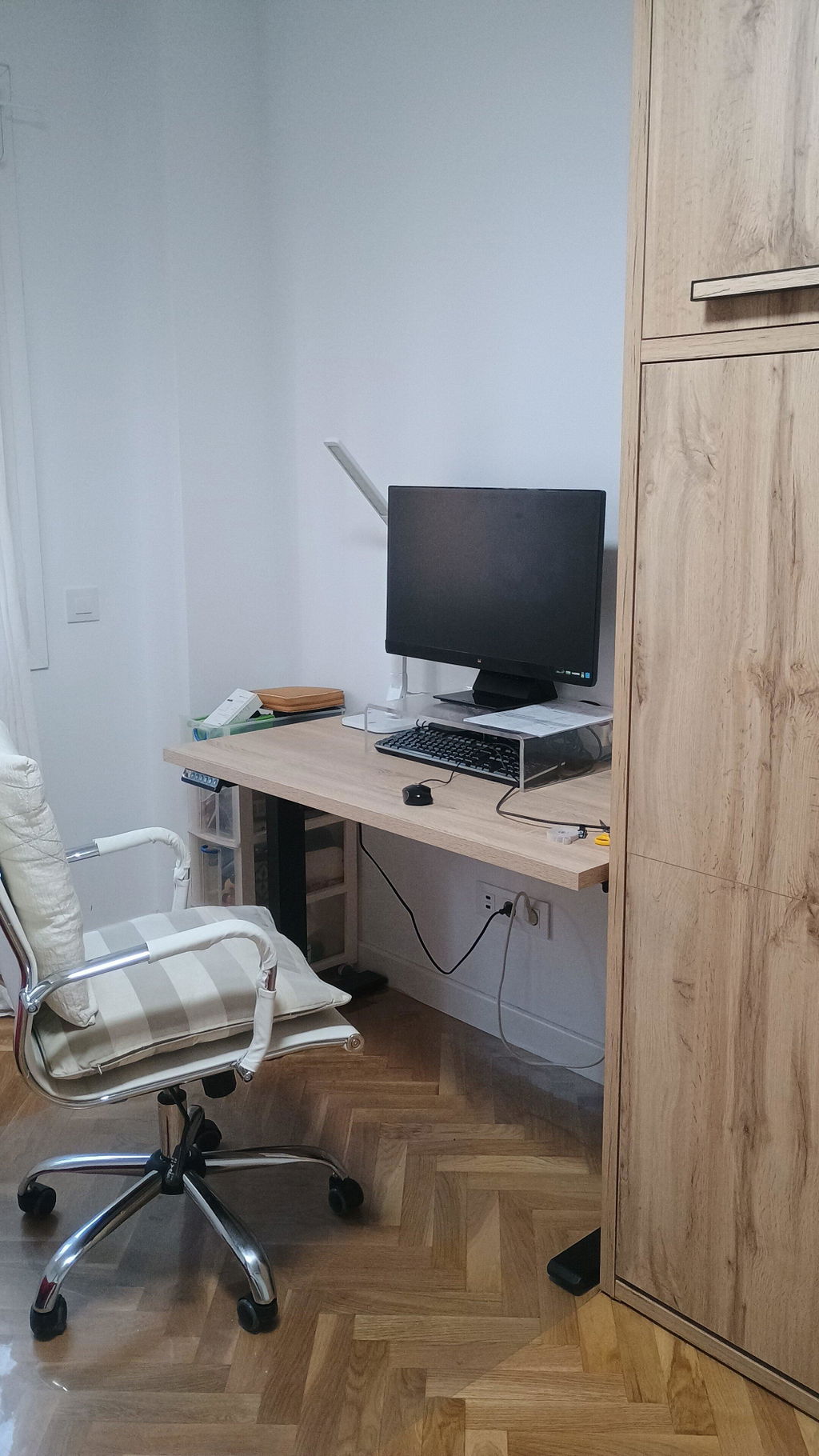

Benefits of a standing desk for health and productivity
Compartir
We spend many hours in front of the computer. Sometimes too many.
Meetings, emails, calls, spreadsheets, concentration tasks, team management, design, programming, administration... It doesn't matter what kind of work: if you work in an office or from home, it's easy to end up spending most of your day sitting.
And the problem isn't just sitting.
The problem is spending too many hours in the same posture.
That's why standing desks have become an increasingly common solution in offices, remote workspaces, and modern workstations. Not because working standing up is a trend, but because they allow for something much more important: changing posture, moving more, and adapting the desk to the person, not the other way around.
In this article, we'll look at the main benefits of a standing desk for postural health, comfort, and productivity.
The key isn't working while standing: it's moving more
It's worth clarifying from the outset: a standing desk isn't for standing for eight hours. Sitting all day isn't ideal, but standing all day isn't usually comfortable or recommended either.
The real advantage of a standing desk is that it allows you to alternate.
Sitting. Standing. Sitting again. Standing for a while.
Small changes throughout the day help prevent the body from remaining immobile for so many hours.
The best posture is not a specific posture. The best posture is the one you don't maintain for too long. If you want to delve deeper into this point, you can also read our guide on how many hours it is recommended to work standing up.
1. Helps reduce the time you spend sitting
One of the clearest benefits of a standing desk is that it makes it easier to stand up more often during the day.
With a fixed desk, standing up means interrupting your work. You have to stop, put away your computer, move away from your desk, and find another time to move.
With a standing desk, the change is much simpler. You raise the desk, continue working, and change your posture without breaking your rhythm.
This can help you build a less sedentary routine, especially if you spend many hours in front of the computer.
You don't have to make radical changes.
You can start with something as simple as working standing for 15 or 20 minutes in the morning, repeating it after lunch, and doing it again in the mid-afternoon.
The important thing is not to achieve a perfect number. The important thing is to introduce more movement into your day.
2. Facilitates a more comfortable working posture
Each person has a different height. Yet, most traditional desks have a fixed height.
That is one of the biggest problems with conventional desks.
A height that is comfortable for someone 1.75 m tall may be too high for someone 1.60 m tall or too low for someone 1.90 m tall.
With a standing desk, you can adjust the height of your desk, so that your posture is more natural, both sitting and standing.
As a general reference:
Elbows should be bent at approximately 90 degrees.
Shoulders should remain relaxed.
Wrists should be straight when using the keyboard and mouse.
The screen should be at a height that doesn't force you to strain your neck.
A standing desk allows you to better adjust all these elements and adapt the workstation to your body, not the other way around.
If you have questions about specific measurements, you can consult our guide on the ideal desk height.
3. Can help reduce back, neck, and shoulder discomfort
Many back, neck, and shoulder discomforts do not appear for a single reason, but for a sum of small things repeated for hours.
A poorly adjusted chair.
A desk that is too high.
A monitor that is too low.
Tense shoulders.
Back leaning forward.
Neck constantly looking down.
A standing desk is not a magic solution, but it can help improve workstation setup and facilitate posture changes throughout the day.
By alternating between working sitting and standing, it is easier to avoid staying in the same position for many hours. And that can help reduce certain discomforts associated with sedentary work and poor ergonomics.
The key is to use it well.
It's not about raising the desk and forgetting about it. It's about listening to your body, changing posture, and adjusting the height to work comfortably.
4. Provides more energy throughout the day
I'm sure it's happened to you before.
You've been sitting for several hours, you look at the screen and you find it hard to concentrate. You get up, take a few steps, stretch your legs a bit and your body seems to reactivate.
Changing your posture has that effect.
Working standing up for some moments of the day can help you feel more active, especially during those periods when energy levels tend to drop: after lunch, in the mid-afternoon, or during repetitive tasks.
It doesn't mean you'll be more focused by magic.
But it can help you break the feeling of physical blockage that appears when you've been sitting for too many hours.
Sometimes you don't need another coffee. Sometimes you need to change your posture.
5. Can improve concentration for certain tasks
Not all tasks are worked on equally.
There are times when sitting is most comfortable: writing a long document, reviewing numbers, working with precision, or having a lengthy meeting.
But there are also tasks that many people prefer to do standing:
30-minute calls.
Quick email review.
Internal meetings.
Day planning.
25 or 30 minute concentration sessions.
Working while standing can provide a more active and dynamic feeling, especially for tasks that don't require being completely still.
That's why a standing desk makes sense not only from an ergonomic point of view. It can also help you better organize your work method.
You can reserve the standing position for more agile tasks and the sitting position for longer or more analytical tasks.
6. Makes it easier to apply routines like the Pomodoro technique
A very simple way to combine productivity and movement is to use the Pomodoro technique.
The idea is to work in 25-minute concentration blocks, followed by a short 5-minute break.
With a standing desk, you can take advantage of these cycles to alternate postures:
25 minutes working standing. 5-minute break.
25 minutes working sitting. 5-minute break.
25 minutes working standing. And so on.
It's a practical way to incorporate movement without having to constantly think about when to stand up or sit down.
The standing desk becomes another tool in your work routine.
It doesn't just change the height of the desk. It can also help you change the pace of your day.
7. Adapts better to different people and spaces
A fixed desk forces everyone to adapt to the same height.
A standing desk allows for the exact opposite.
It adapts to the user.
This is especially useful in homes where several people use the same desk, in offices with shared workstations, or in workspaces where each person has different needs.
It is also very practical for those who combine different uses at the same desk:
- working with a laptop,
- using multiple monitors,
- studying,
- making calls,
- editing video,
- gaming,
- reading documents,
- or simply changing posture during the day.
- A good standing desk allows you to configure your workspace much more flexibly.
And that flexibility is especially noticeable when working remotely.
When your home is also your office, having a comfortable and adaptable workstation stops being a luxury. It becomes an important part of your daily life.
All Tablakala standing desks include 4 memory positions, so that several people can save their favorite heights on the same desk, and change position with a single click.
A standing desk is an investment in your workspace
Many times we place great importance on the chair, the monitor, the computer, or the lighting. And that makes sense.
But the desk also matters.
The desk is the foundation of the workstation. It's where you place your computer, your arms, the screen, the keyboard, the mouse, and everything you use for hours.
An uncomfortable desk affects your entire posture.
A stable, sturdy, durable, and adjustable desk can greatly improve the work experience.
That's why a standing desk shouldn't just be seen as a table that goes up and down. It's a way to adapt your workspace to your body, your routines, and your way of working.
If you are considering changing your current desk, you can view our collection of standing desks.
Why choose a Tablakala standing desk?
At Tablakala, we design standing desks for those seeking a stable, durable desk with good value for money.
Our tabletops are made of wood, are 3 cm thick, and are manufactured in Spain. This provides a sense of warmth, solidity, and quality that is noticeable both in daily use and in the desk's durability.
Furthermore, we have different models to adapt to different needs.
The Tablakala 1 Motor model is a very balanced option for remote work, study, and home office.
The Tablakala 2 Motors model offers higher performance, more load capacity, greater stability, and faster height adjustment.
If you have doubts between the two, you can read our comparison of the differences between Tablakala 1 Motor and Tablakala 2 Motors.
We also offer an extended 5-year warranty, fast shipping from Peninsular Spain, and verified reviews from real customers.
Because a standing desk shouldn't just be comfortable on the first day. It should continue to function well for years.
Conclusion: the real benefit is working more dynamically
The benefits of a standing desk don't come from standing all day.
They come from moving more.
From alternating postures.
From adjusting the desk to your height.
From working more comfortably.
From avoiding spending eight consecutive hours in the same position.
A standing desk helps you turn your workstation into a more flexible space, better adapted to you.
And that, when you spend many hours in front of the computer, can make a significant difference in how you work and how you feel at the end of the day.