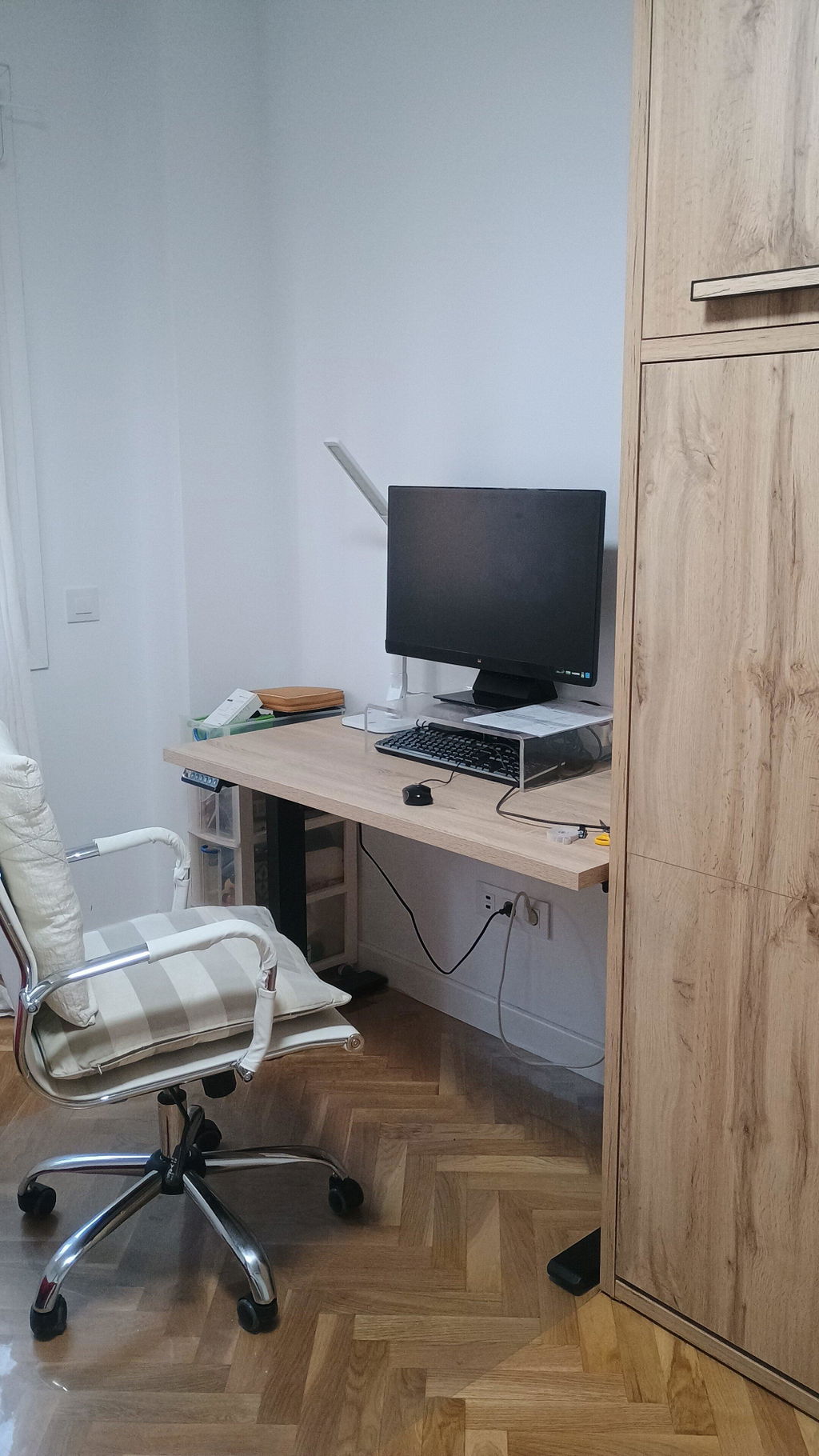

How many hours is it recommended to work standing up?
Height-adjustable desks have changed the way many people work. More and more professionals are alternating between sitting and standing throughout the day, seeking a more dynamic and comfortable posture.
However, one of the most common questions is: how many hours is it recommended to work standing?
The short answer is simple: working standing can offer numerous benefits, but spending the entire day standing is not recommended either. The key is to alternate positions, change posture, and keep the body moving.
The best posture is the one you don't hold for hours
There is a belief that working standing may be better than working sitting. Nothing could be further from the truth.
In reality, the best posture is neither. The best posture is the one you don't hold for hours. In other words, the key is to add movement to your routine.
Our body is designed to move. Remaining seated for 8 consecutive hours can be uncomfortable and not recommended for our postural health. But remaining standing for eight consecutive hours is not a good idea either.
That's why height-adjustable desks have become so popular in offices and work-from-home spaces. They allow you to easily change positions throughout the day without interrupting work.
How long is it recommended to work standing?
The first thing you should know is that there is no exact figure valid for everyone.
Most ergonomics specialists agree that it is best to alternate periods of sitting and standing work regularly.
If you have never used a height-adjustable desk, you can start with short sessions:
- 10 minutes standing every hour.
- 15 minutes standing every hour.
- 20 minutes standing every hour.
- 30 minutes standing every hour.
Over the days, you can adjust these times, depending on how you feel.
Many active people who actually use height-adjustable desks end up working approximately 1 to 4 hours standing spread throughout an 8-hour workday.
The important thing is not to reach a specific figure, but to avoid staying in the same position for too long. Alternate between sitting and standing. Standing and sitting.
Signs you've been sitting too long
It is common for people to start noticing certain discomforts when they spend many hours sitting:
- Back stiffness.
- Neck and shoulder tension.
- Feeling of heaviness in the legs.
- Lack of concentration.
- General fatigue.
When these signs appear, getting up for a few minutes is usually a good idea.
Signs you've been standing too long
Working standing has advantages, but it's not good to overdo it either.
Some signs that you need to sit down again are:
- Tiredness in legs or feet.
- Lower back discomfort.
- Feeling of strain in the knees.
- Need to constantly shift weight from one leg to the other.
At that moment, it is best to return to a sitting position for a while.
The simplest method: alternate throughout the day
Instead of asking yourself how many hours you should work standing, it may be more useful to ask yourself how often you should change your posture.
A simple strategy is to regularly alternate between sitting and standing work.
For example:
- 30 minutes sitting.
- 30 minutes standing.
- 30 minutes sitting.
- 30 minutes standing.
It is not necessary to be strict. The important thing is to introduce variety and movement throughout the day.
The Pomodoro Technique and height-adjustable desks
A very practical way to combine productivity and ergonomics is to use the Pomodoro Technique.
This method consists of working in concentrated blocks of 25 minutes followed by a short 5-minute break. It is called this ("Pomodoro") because its creator, an Italian university student, used a mechanical kitchen timer in the classic shape of a tomato (whose translation into Italian is "pomodoro") to measure his study times.
The Pomodoro technique would be as follows:
- Choose a task: select the activity or project you want to focus on.
- Set the timer: set an alarm for 25 minutes.
- Work without interruptions: dedicate yourself fully to that single task until the timer goes off. No multitasking or checking your phone is allowed.
- Take a short break: when the alarm goes off, take a 5-minute break to stretch, move, drink water, or breathe.
- Complete the cycles: after every four "pomodoros," take a longer break of about 15 to 30 minutes, to allow your brain to recover.
If you use a height-adjustable desk, it's ideal, because you can take advantage of these cycles to alternate positions:
- Pomodoro 1: 25 minutes working standing.
- Active break: 5 minutes stretching or moving.
- Pomodoro 2: 25 minutes working sitting.
- Active break: 5 minutes stretching or moving.
- Pomodoro 3: 25 minutes working standing.
- Active break: 5 minutes stretching or moving.
This way, you introduce movement naturally without constantly having to check the clock.
In addition, many people discover that certain tasks are more comfortable for them standing, while others require a more relaxed sitting position.

Why does a height-adjustable desk facilitate this change?
Changing posture several times a day is easy to say, but much more difficult to do when using a conventional desk.
With a height-adjustable desk, you can switch from a sitting to a standing position in a matter of seconds.
This eliminates much of the friction and makes it much easier to incorporate movement into your daily routine.
If you still don't know how they work, you can browse our collection of height-adjustable desks and discover the different options available.
Adjust the height correctly
Working standing is only comfortable when the desk height is appropriate.
If the desk is too high or too low, discomfort in the neck, shoulders, or back can appear.
That's why it's important to adjust the height correctly both when working sitting and when working standing.
If you have doubts about the correct height, we recommend reading our complete guide on the ideal desk height.

Is it better to work sitting or standing?
The reality is that no posture is perfect if maintained for too many hours. The most recommended approach is to alternate between working sitting and standing throughout the day.
A height-adjustable desk facilitates this change of posture and allows you to adapt your workspace to each moment of the day.
Conclusion
There is no magic number of hours you should work standing each day.
It is best to start little by little, for example with periods of 15 minutes standing, every 1 or 2 hours of work, and regularly alternate between sitting and standing, adapting the times to your needs and sensations.
The goal is not to replace one posture with another, but to avoid staying in the same position for too long.
Introducing more movement into your workday will help you feel more comfortable, maintain concentration, and reduce the discomfort associated with long hours of computer work.
If you want to start alternating between sitting and standing, a height-adjustable desk can help you do it easily during your workday.